
In Georgia, workers confront two types of right-wingers
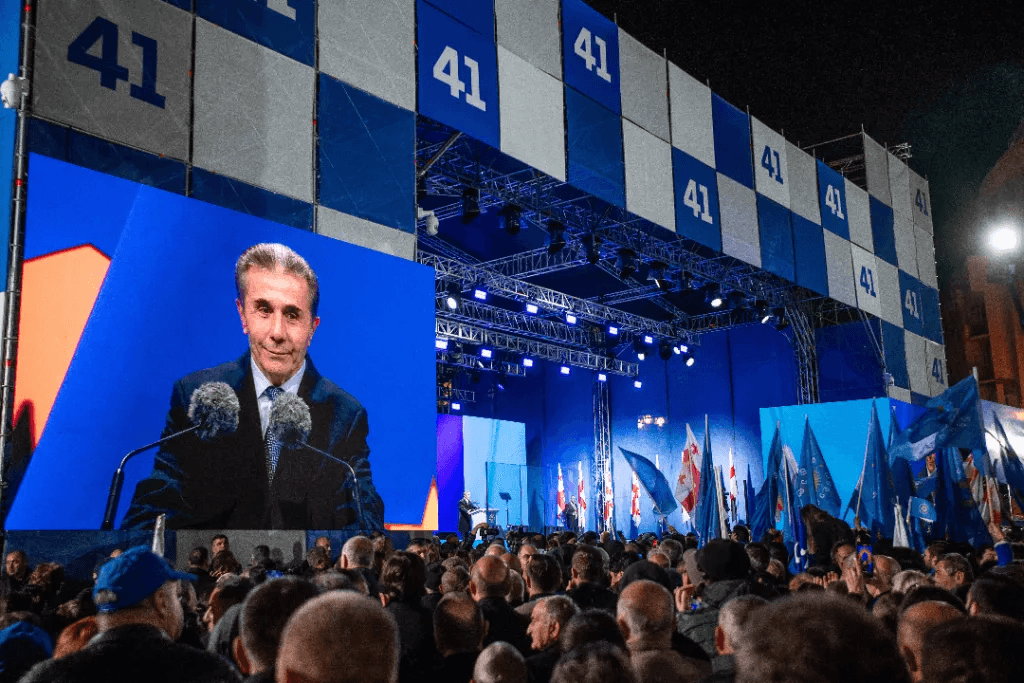
Many view Saturday’s elections in Georgia as a decision about the country’s geopolitical orientation. For labor activists the task is to put social issues on the agenda, confronting both the government’s autocracy and an opposition that ignores workers’ interests.
“They don’t admit it officially, but everyone knows these guys work for the company. And they are very aggressive toward us, the strikers,” explains thirty-year-old union activist Tamar Ansiani. She nods toward a group of men who stand guard between the picket line and her workplace. They are all dressed in black, some of them wearing masks. Ansiani and her comrades call them “zonders” — a word derived from the Nazi term “sonderkommando,” meaning groups of people in civilian clothes hired to intimidate political opponents.
This phenomenon is not unique to Georgia. During the Maidan revolution in Ukraine in 2014, similar squads known as “titushki” attacked anti-government protesters. It is also not entirely new in Georgia. More than a decade ago, when the neoliberal pro-western reformer Mikheil Saakashvili suppressed protests, zonders were part of his repressive arsenal.
Yet this shows how little the political culture has changed, despite the fact that the former opposition party Georgian Dream has ruled the country for twelve years. Zonders have returned to the scene recently. This spring, during mass demonstrations against the so-called foreign agents law, zonders suspected of ties to the authorities beat protesters under cover of night. “It’s the same as during the protests,” says Ansiani’s colleague and striker Kamil Azimovi, who was beaten in September at his home by masked men. He believes the attack was an attempt to intimidate him and force him out of the strike. But the use of zonders to protect a Western corporation from striking workers is a novelty that highlights what lies behind the geopolitical clichés dominating public discussion.
With parliamentary elections approaching this Saturday, Georgia has been plastered with campaign posters for several weeks. On the posters of the ruling party Georgian Dream, billionaire Bidzina Ivanishvili’s party, images of devastation in Ukraine are contrasted with blossoming urban landscapes in Georgia. They offer a choice: a pro-Western opposition that supposedly seeks war with Russia, or a government that provides peace. The opposition, much of which still comprises the political bloc of the now-incarcerated former president Mikheil Saakashvili, promises Georgia’s integration with the West, which supposedly will bring freedom and prosperity. The material hardships faced by most Georgians are practically not mentioned in the official campaign.
Union initiatives
The strike in which Ansiani and her union confront anonymous thugs has been ongoing since July and is one of the largest in modern Georgian history. The employer in question is the Swedish company Evolution Gaming, which provides online casino services to clients around the world. Drawn by Georgia’s deregulated economy, low wages, and perhaps a weak labor movement, Evolution came to Tbilisi in 2018, and since then its studio has become one of the country’s largest private employers.
Part of the reason the company (or government officials who the union suspects have a stake in it) resorted to such brazen intimidation may be that the union “Trud”, of which Tamar Ansiani is vice-president and which opposes the company, is not the usual weak representative of workers in the Georgian landscape. On the contrary, it is one of several new union initiatives that in recent years have given the Georgian labor movement a new militancy.
“Unlike most other unions, we organize people and fight, and I think that makes us a problem in the eyes of the government,” says Ansiani, while her comrade, union president Georgy Diasamidze, nods proudly. According to them, the struggle to improve Georgian workers’ conditions inevitably has a political character. In the spring the union took an active part in protests against the government’s foreign agents law. The government asserts that this law, which introduces strict auditing requirements for any nonprofit organization receiving more than 20 percent of its funding from abroad, will provide necessary transparency in an expanding NGO sector funded from overseas.
But Trud sees it as an authoritarian measure threatening their organization. Since Georgian workers can hardly afford union dues, grassroots unions depend on solidarity from abroad. That Trud was able to provide strikers with legal assistance and set up tents on the picket line at Evolution became possible thanks to support from international partners such as UNI Global Union and the Danish Confederation of Trade Unions.
“If we protect Georgian workers from foreign companies with the support of international partners, and the government does nothing — how does that make us foreign agents?” asks Diasamidze. If Trud agreed to the new law, from which they fundamentally refuse to compromise, Ansiani says they would, among other things, have to hand over to the authorities personal information about their members and planned actions. Trying to halt what she considers authoritarian tendencies of the ruling party, Ansiani plans to leave Tbilisi for the first time since the strike began in order to vote in her hometown. “These elections are a choice for Georgians about what they want — Europe or Russia,” she says.
It may seem odd that she uses the same geopolitical rhetoric as Georgia’s liberal opposition, given her current struggle with a company from the EU. But the hopes she and her union comrades attach to the idea of Europe differ from those of the liberals.
Although Ansiani and Diasamidze hope to see Georgian Dream removed from power, they are also not admirers of the current opposition, given that many of its representatives still adhere to the libertarian ideology that damaged workers’ rights under Saakashvili. “Most Georgian politicians are really mistaken about Europe, deregulation, and the free market,” says Diasamidze, referring to both the ruling party and the opposition. “The previous government liquidated the labor safety inspection, claiming it was corrupt. But the police were also corrupt, and for some reason it was considered sufficient to just reform them,” he laughs. “And when Georgian Dream eventually restored that agency, it was done only to satisfy international pressure,” he explains, adding: “From our point of view, Europe means some basic regulation.”
Autocracy
The union activists’ concerns about Georgian Dream’s authoritarian tendencies are shared by many in Georgia’s left-wing opposition. “What worries us most is the increasing authoritarianism,” says journalist Ani Georgadze. However, in the view of her colleague Natia Karchiladze, geopolitical terminology is not quite suitable for describing the problem. “When we talk about democracy and authoritarianism, it’s actually not about geopolitics,” she says. Both women work at the leftist online outlet Mautskebeli, which covers social issues such as the ongoing strike at Evolution. The outlet’s main office is on a quiet residential street near Tbilisi’s central station, and on its modest walls is a bookshelf with books by David Graeber and Yanis Varoufakis.
Like Ansiani’s union, Mautskebeli also falls under the foreign agents law but so far refuses to comply. Mautskebeli is funded by European donors such as the Heinrich Böll Foundation, associated with the German Greens. While the journalists admit this is not a perfect solution, since such funding also imposes certain constraints, they consider it the best of the available options for those who want to cover important issues.
“Once we negotiated with a potential American donor, but after we published several posts about Palestine as we saw fit, he disappeared without explanation,” Georgadze recalls. And while Mautskebeli hopes to reduce dependence on foreign grants through crowdfunding, this is not a viable alternative given the dire situation of ordinary Georgians whose lives Mautskebeli aims to cover. Funding from Georgian political parties or business, which pays for a large portion of Georgian media — both pro-government and opposition outlets — would mean far less independence than Mautskebeli currently has.
This is evidenced by the fact that, despite the ongoing election campaign, some of Georgia’s most acute social conflicts are practically not covered by the main national news media. According to Georgadze and Karchiladze, large businesses like Evolution or the mining giant Georgian Manganese, which became the object of a weeks-long hunger strike by rural residents from central Georgia whose homes are being destroyed by its activities, provide opportunities for enrichment to politicians from both the government and the opposition. It is symptomatic of Georgia’s democratic deficit that media affiliated with these party and business interests are not interested in critical coverage of events.
But while Georgia’s dominant political factions largely ignore the problems of working Georgians, grassroots left initiatives are trying to build new alliances. One such example is “Praktika” — an initiative that calls itself a “working-class café,” which opened near central Tbilisi in 2022. “All we had at the start was a bread oven that one of the supporters gave us,” recalls Georgi Hasaia. He sits in a cramped back room of the café with his comrades Georgi Kartvelishvili and Akaki Chikobava. All three are academics and members of the socialist movement Khma, which runs Praktika.
“We try to bring socialist politics into the public sphere,” Hasaia explains the movement’s goals. In terms of political agitation this includes various campaigns, for example demanding that the state provide free meals for schoolchildren. Unlike grants from abroad, Khma’s modest funding comes from Praktika.
The café is filled with the smell of coffee and lively conversations mostly among young visitors. Offering inexpensive drinks and food for students and low-paid workers, the café serves as a meeting place for social movements and initiatives that, despite shared interests, might not otherwise meet.
Given the lack of clearly left spaces that could foster such connections, the café provides unique infrastructure for class organization. When striking miners from Georgian Manganese came to Tbilisi with their demands last year, Praktika provided them with free accommodation during their stay in the capital. Like the journalists at Mautskebeli, Khma activists believe that the apparent fault lines in Georgian politics largely conceal deeper class antagonisms in society.
Two right wings
While the ruling conservatives and their main pro-Western liberal opponents accuse each other of being puppets of Russia or the West respectively, neither side offers voters anything substantial in terms of economic or social policy.
“To paraphrase Lawrence Ferlinghetti: the Georgian political class is a bird with two right wings,” says Hasaia. In his view, even the geopolitical commitments professed by these two “right wings” — Georgian Dream’s promises to strengthen national sovereignty or the opposition’s promise to secure a European future — lack much substance.
For Khma activists the foreign agents law is a striking example. While they agree that some large NGOs funded by the West have had a harmful impact on Georgian politics, for example by lobbying against progressive taxation, they are confident that such organizations have the resources to adapt to the law or pay fines if they do not. They believe it is grassroots social movements that will suffer most. According to Kartvelishvili, it is these movements that are likely the real targets of the legislation. “When leading politicians of Georgian Dream promoted this law, they said it would uncover agents behind recent protests against the construction of hydropower plants, which were not even registered NGOs,” he explains. “And so-called foreign funding in those cases mainly consisted of donations from Georgian labor migrants in Europe and the US,” adds Chikobava.
They believe the anti-Russian stance touted by liberals is also insincere. According to Hasaia, “this harsh form of neoliberalism brought to Georgia by Saakashvili and his oligarch-ally Kakha Bendukidze was inspired more by Russian architects of economic shock therapy implemented in Russia in the 1990s than by Western models. Georgian capitalism is capitalism in the Russian manner,” says Kartvelishvili. “While we demand the nationalization of Russian capital, liberals cannot overcome their free-market ideology and do the same,” Hasaia laughs.
Nevertheless, Khma activists also consider the elections important. “It’s a matter of defending democracy, in the sense of restraining the ruling party and preventing it from turning into this triumphant, authoritarian bourgeoisie that will expand capital even faster,” says Kartvelishvili.
Although the elections may be a chance to halt further deterioration in politics, none of the opposition parties promises substantial changes for workers — let alone radical changes to Georgia’s clearly anti-worker status quo.
However, for Khma and others hoping for a post-election reality that would allow building a left movement, there are some encouraging signs of change. “Many young people are starting to take more interest in socialist ideas,” says Hasaia. “Even some of those studying at the private university founded by [Kakha] Bendukidze, the father of Georgian neoliberalism, are sensibly leaning toward progressive politics,” Kartvelishvili laughs.
Moreover, at least one of Khma’s campaigns has managed to penetrate the current electoral campaign. “Almost every party has included in its programs a promise of free school meals,” says Hasaia, who is convinced this happened thanks to Khma’s agitation. While activists admit it is awkward to see politicians adopt the demand, they welcome it as a change from the usual stance of only asking that things not get worse. “We persuaded a significant number of people that it’s a good idea, that it will work and help them in daily life. We won that battle,” says Hasaia.
Regardless of the election outcome, the persistence of labor and social movements will remain a key factor in the struggle for a different, fairer future for Georgia. And for Tamar Ansiani and her striking colleagues, their fight will continue until their demands are met. The union underlined its determination in early October when it brought a trailer to the picket line as additional shelter for the strikers. “Of course, winter is coming, but we will stay here no matter what,” Ansiani says confidently.
Original article: https://jacobin.com/2024/10/georgia-labor-elections-repression-europe
From the editors:
This is an article about elections in Georgia; nevertheless it is also relevant for Russia. We also have two right wings here, only one of them is broken or rather detached. The opposition in Russia is effectively destroyed, as are the opportunities for grassroots initiatives, social movements and genuinely independent unions.
The consequence of this is petitions as the only form of protest in recent years. A step to the right, a step to the left, an unsanctioned action or even a post on social media and you’re in prison.
A dictatorial regime is established in the country. Therefore the agenda is not a communist or anarcho-communist revolution, but simply creating opportunities for public and political struggle. For the development of the labor movement we need democracy, even if it turns out that it has two right wings.